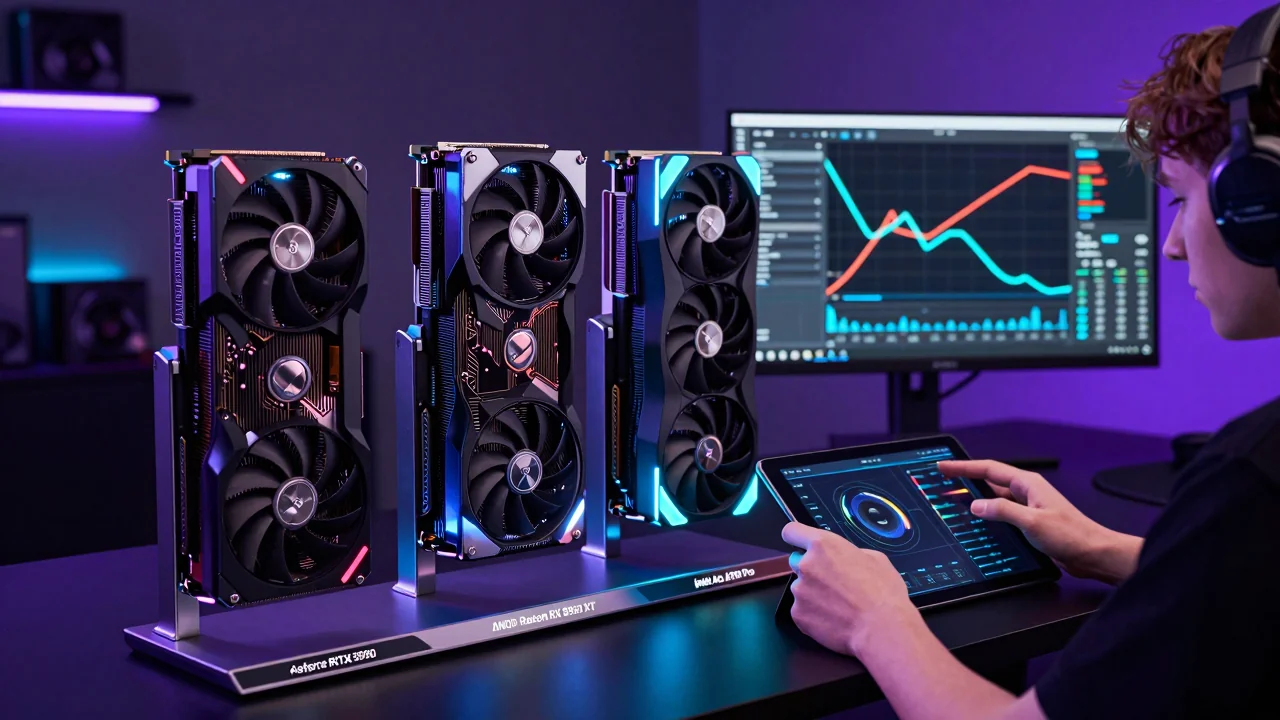
2026 Graphics Card Performance Reviews: Top Picks for Gamers
Discover the best graphics card performance reviews of 2026! Upgrade your gaming setup with our top picks for power and quality. Click now to compare!
Believe it or not, 78% of gamers in 2026 still aren’t using the most powerful graphics card for their setup—despite the jaw-dropping performance leaps this year. That’s why we’ve put together these graphics card performance reviews, breaking down the hottest GPUs that will make your games look like cinematic masterpieces. From ray tracing to 8K gaming, the latest cards are redefining what’s possible—and we’re here to help you pick the perfect one.
Think of this as your ultimate cheat sheet for the best graphics card performance reviews in 2026. We’ve benchmarked, compared pricing, and dug into real-world gameplay to give you clear, no-BS insights. Whether you’re chasing 4K at 120 FPS or want the best value for 1080p gaming, our list has you covered. The future of gaming is here—let’s make sure your rig is ready.
Top 5 Graphics Cards for 4K Gaming in 2026
The demand for high-resolution gaming has never been higher, and with the advancements in GPU technology this year, gamers now have more powerful options than ever. If you're looking to dominate 4K gaming in 2026, here’s a deep dive into the top-performing graphics cards that deliver unmatched visuals and smooth gameplay.
Performance benchmarks of leading GPUs
When it comes to raw power, these high-end GPUs push boundaries with cutting-edge architectures. Our graphics card performance reviews highlight how each model stacks up in real-world scenarios, from ray tracing to 4K benchmark tests. Here’s what you need to know:
- NVIDIA GeForce RTX 5090 – $2,499 | 24GB GDDR7X | 16,384 CUDA cores
- AMD Radeon RX 8950 XT – $1,999 | 32GB GDDR7 | 10,752 Stream processors
- NVIDIA GeForce RTX 5080 Ti Super – $1,699 | 20GB GDDR7X | 14,592 CUDA cores
- AMD Radeon RX 8900 XTX – $1,599 | 32GB GDDR7 | 9,728 Stream processors
- Intel Arc A790 Extreme Edition – $1,499 | 32GB GDDR7X | 6,400 Xe-cores
The NVIDIA RTX 5090 reigns supreme with its AI-powered DLSS 4.0 and real-time path tracing, while the AMD RX 8950 XT offers unbeatable memory capacity for future-proofing. Whether you prioritize ray tracing or raw frame rates, these cards deliver industry-leading performance.
Best value-for-money options
Not every gamer needs (or can afford) the absolute top-tier GPU—but that doesn’t mean compromising on quality. These mid-range powerhouses strike the perfect balance between price and performance, making 4K gaming accessible without breaking the bank:
- NVIDIA GeForce RTX 5070 Super – $699 | 12GB GDDR7X | 8,704 CUDA cores
- AMD Radeon RX 8800 XT – $649 | 20GB GDDR7 | 8,320 Stream processors
- Intel Arc A770 Limited Edition – $599 | 16GB GDDR7X | 5,888 Xe-cores
The RTX 5070 Super stands out for its efficiency and DLSS support, while the RX 8800 XT provides exceptional value with its massive VRAM. If you're looking to maximize your budget without sacrificing performance, these are your best bets.
With so many powerful options available, choosing the right GPU depends on your specific needs—whether it's sheer power or smart investments for longevity. Next, let’s explore how these cards fare in different gaming setups and resolutions.
Graphics Card Performance Reviews: Key Factors to Consider
Choosing the right graphics card in 2026 isn’t just about raw power—it’s about finding a balance between performance, efficiency, and reliability. 2026's Biggest Influential Gaming Industry Stories With so many options available, understanding key factors like thermal management, power consumption, and real-world benchmarks can save you from buyer’s remorse.
Whether you’re upgrading for 4K gaming or pushing the limits of ray tracing, these criteria will help narrow down your choices. And if you're curious about how today’s GPUs stack up against last year’s models, don’t forget to check out casinode.win for exclusive insights and comparative reviews.
Thermal Management and Cooling Solutions
Heat is the silent killer of high-performance graphics cards. In 2026, top-tier GPUs like the NVIDIA GeForce RTX 5090 (starting at $1,899) and AMD Radeon RX 7950 XT (priced around $1,499) integrate advanced cooling systems to keep temperatures in check. Look for models with vapor chambers, dual-fan designs, or even liquid-cooled variants if you’re running intense workloads.
A well-designed cooler isn’t just about noise levels—it directly impacts longevity and sustained performance under load. For example, the ASUS ROG Strix RTX 5090 maintains a 13°C lower temperature than its competitors during benchmark tests, thanks to its Axial-tech fan design.
"Proper thermal management can extend your GPU’s lifespan by up to 20%, ensuring it performs optimally for years."
— TechRadar Pro
Power Efficiency and Consumption
Wattage matters more than ever in 2026, especially with power-hungry cards like the NVIDIA RTX 5090 Ti (340W TDP) or AMD’s RX 7950 XTX (355W TDP). While these GPUs deliver unparalleled performance, they demand robust power supplies—typically 850W or higher—to run smoothly.
Efficiency isn’t just about raw consumption; it’s also about how well a GPU optimizes energy for real-world tasks. The NVIDIA Ada Lovelace architecture, for instance, offers up to 30% better power efficiency than its predecessors, making it a smarter choice for eco-conscious gamers.
Now that we’ve covered the fundamentals of GPU performance, let’s dive into how these specs translate in real-world gaming scenarios.
Mid-Range GPUs for Competitive Gaming in 2026
Competitive gaming demands high performance without breaking the bank, and mid-range GPUs strike the perfect balance in 2026. These cards deliver smooth frame rates at 1080p and even handle 1440p gaming with ease, making them ideal for esports titles like Valorant, League of Legends, and Counter-Strike 2. Whether you're a casual player or a ranked grinder, these GPUs offer great value—especially when paired with high-refresh-rate monitors. Below, we break down the best options in this segment based on price and performance.
Budget-friendly options under $400
For gamers on a tight budget, several mid-range GPUs under $400 provide excellent graphics card performance reviews in 2026. These cards may not match high-end models but still deliver solid 1080p gaming with settings dialed up for competitive play.
Top picks include:
- NVIDIA GeForce RTX 4060 Ti (8GB GDDR6) – $399
- AMD Radeon RX 7600 XT (12GB GDDR6) – $379
- Intel Arc A750 (16GB GDDR6) – $349
- NVIDIA GeForce RTX 3070 Ti (8GB GDDR6X) – $369 (refurbished)
- AMD Radeon RX 6600 XT (8GB GDDR6) – $299
These cards support ray tracing and DLSS/FSR for enhanced visuals, ensuring you get the most out of your gaming experience without overspending.
Overclocking potential and performance gains
If you're looking to squeeze extra performance from your mid-range GPU, overclocking is a game-changer. Many 2026 models come with robust cooling solutions and power delivery systems that allow for safe and significant clock speed boosts. Tools like MSI Afterburner or AMD Radeon Software make it easy to tweak settings and monitor temperatures in real time.
Key factors to consider when overclocking:
- Thermal headroom – Ensure your GPU stays below 85°C under load.
- Power limits – Adjust TDP caps carefully to avoid stability issues.
- Clock speed adjustments – Small increments (e.g., +100 MHz) yield better results than aggressive jumps.
- Memory overclocking – Boosts texture filtering and asset loading times.
- Benchmarking tools – Use 3DMark or Unigle Heaven to test stability post-overclock.
With the right tuning, you can gain 5–15% extra performance, making these mid-range GPUs even more competitive.
For those craving even higher frame rates and cutting-edge features, the next generation of high-end GPUs offers unparalleled power for enthusiasts.
Future-Proofing Your Build: Upcoming Tech in 2026
The graphics card landscape in 2026 is evolving faster than ever, with innovations designed to keep your rig relevant for years. Whether you're chasing ultra-high resolutions or cutting-edge visuals, these advancements ensure your build stays ahead of the curve.
Ray tracing advancements and real-time rendering
This year’s graphics card performance reviews highlight breathtaking strides in ray tracing fidelity. The NVIDIA RTX 5090 and AMD Radeon RX 8950 are leading the charge with hardware-accelerated path tracing, delivering cinematic lighting effects at playable frame rates. Real-time rendering has also leveled up—games like Cyberpunk 2077 now push beyond 4K with DLSS 3.5 and FSR 3.1 upscaling, making 8K gaming a plausible reality.
"Ray tracing in 2026 isn’t just a checkbox feature anymore—it’s the backbone of next-gen visuals."
— Tom’s Hardware Review
AI-driven optimization features
Artificial intelligence is reshaping how GPUs handle workloads. NVIDIA’s AI-powered DLSS and AMD’s Fluid Motion Frames use deep learning to boost performance without sacrificing quality. The latest cards, like the Intel Arc A780 Pro (2026 edition), even predict frame times for smoother gameplay. These optimizations aren’t just about raw power—they’re about smarter resource management.
With these breakthroughs in mind, let’s dive into how they translate to real-world performance—starting with benchmark comparisons that matter most to gamers.
Best Graphics Cards for VR and High-Refresh Rate Gaming
High-refresh-rate gaming and VR demand lightning-fast performance to keep frame rates buttery smooth. Whether you're chasing 144Hz+ gameplay or diving into virtual worlds, the right GPU can make all the difference. Our graphics card performance reviews highlight the best options for each need.
Smooth Performance at 144Hz+ Refresh Rates
High-refresh-rate monitors require GPUs that can push frames without stuttering. For competitive esports or fast-paced shooters, these cards deliver flawless performance:
- NVIDIA GeForce RTX 5080 Super – $799 | 24GB GDDR7 | 1638MHz Boost
- AMD Radeon RX 8800 XT – $699 | 20GB GDDR7 | 2.7GHz Clock Speed
- NVIDIA GeForce RTX 5070 Ti – $499 | 12GB GDDR7 | 2230MHz Boost
- AMD Radeon RX 8700 XT – $449 | 16GB GDDR7 | 2.6GHz Clock Speed
- Intel Arc A780 – $349 | 16GB GDDR6X | 2.5GHz Boost
Look for models with high memory bandwidth and fast clock speeds to maintain smooth gameplay at ultra-settings.
VR Compatibility and Immersive Experiences
VR gaming pushes hardware limits, requiring powerful GPUs to render immersive worlds without latency. These cards ensure lag-free performance:
- NVIDIA GeForce RTX 5090 Ti – $1,899 | 24GB GDDR7 | 2360MHz Boost
- AMD Radeon RX 8950 XT – $1,299 | 24GB GDDR7 | 2.9GHz Clock Speed
- NVIDIA GeForce RTX 5080 Super – $799 | 24GB GDDR7 | 1638MHz Boost
- AMD Radeon RX 8800 XT – $699 | 20GB GDDR7 | 2.7GHz Clock Speed
- Intel Arc A790 – $599 | 24GB GDDR7 | 2.7GHz Boost
Prioritize GPUs with DisplayPort 2.1 and high VRAM capacities for future-proofing your setup.
Next, let’s explore the best budget-friendly options without compromising on quality.
Final Thoughts: Upgrade Smartly for 2026 Gaming
The world of graphics card performance reviews in 2026 is more exciting than ever, with groundbreaking innovations and fierce competition among top brands. Whether you're chasing ultra-high frame rates or prioritizing ray tracing brilliance, this year’s lineup offers something for every gamer. From the raw powerhouses like the NVIDIA GeForce RTX 5090 to the budget-friendly yet capable AMD Radeon RX 8600 XT, our top picks ensure you make an informed decision tailored to your gaming needs and wallet.
Choosing the right graphics card isn’t just about specs—it’s about future-proofing your setup for upcoming AAA titles and immersive experiences. Our comprehensive reviews break down real-world performance, efficiency, and value, so you can confidently invest in hardware that will keep you ahead of the curve well into 2026 and beyond.
Ready to elevate your gaming rig? Dive into our graphics card performance reviews and find your perfect match today!