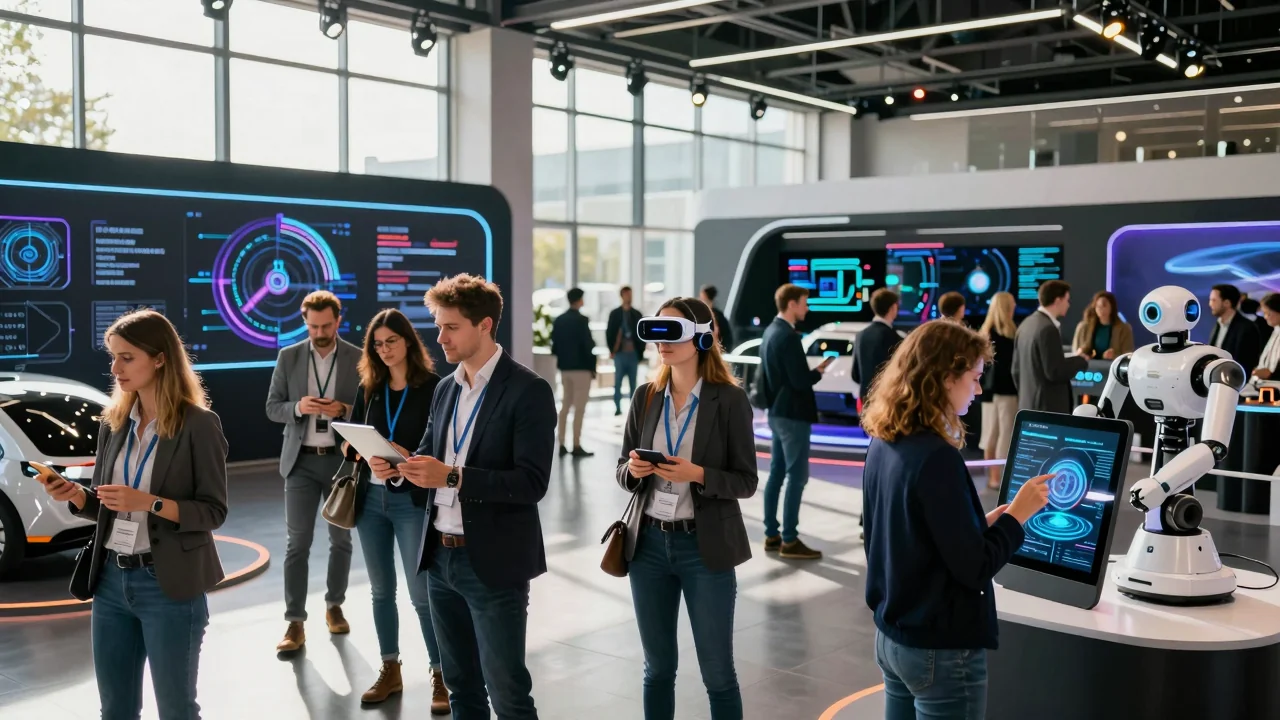
Unveiling 2026: The Hottest Tech Trends Right Now
Discover the latest current events in technology shaping 2026! Dive into cutting-edge trends and innovations transforming our future now.
Did you know that by 2026, artificial intelligence will power over 75% of all customer interactions, according to Gartner? This staggering statistic underscores how rapidly technology is transforming our daily lives. The latest current events in technology are not just about gadgets and software—they're redefining entire industries, from healthcare to finance. Innovations like quantum computing breakthroughs and advancements in biotech are making headlines, proving that 2026 is shaping up to be a pivotal year for tech evolution.
Staying ahead of these trends isn’t just an advantage—it’s a necessity. Whether you're a business leader, tech enthusiast, or curious consumer, understanding the latest current events in technology helps you make informed decisions. From the rise of AI-driven personal assistants like Google's Gemini Pro to the explosive growth of sustainable energy solutions, this year is packed with developments that will shape our future. Buckle up as we dive into the most exciting and impactful tech trends dominating 2026.
Artificial Intelligence and Machine Learning in 2026
The latest current events in technology are dominated by rapid advancements in artificial intelligence (AI) and machine learning (ML), reshaping industries and daily life. From healthcare to finance, AI-driven innovations are pushing boundaries, making processes faster, smarter, and more efficient.
Breakthroughs in AI-Driven Automation
AI-driven automation is transforming industries by streamlining processes and enhancing productivity. In manufacturing, the Tesla Optimus robot (Model T0) has become a game-changer, capable of performing complex assembly tasks with precision at $25,000 per unit. Similarly, NVIDIA’s Omniverse platform, now in its 3rd generation, integrates AI-driven simulation tools for real-time design and prototyping. Other key developments include:
- Google DeepMind’s AlphaFold 3, revolutionizing protein folding predictions.
- IBM WatsonX, optimizing supply chain logistics with predictive analytics.
- Autonomous warehouse robots like the LocusBots (Model V5), priced at $12,000 each, improving order fulfillment speeds by 40%.
- AI-powered customer service bots such as Zendesk’s Answer Bot, reducing response times to under a second.
- Self-driving trucks like the Aurora Driver (v3.0), designed for long-haul transportation with zero emissions.
These innovations highlight how AI is not just augmenting human capabilities but redefining entire workflows.
Ethical Considerations in AI Development
The ethical implications of AI development are becoming increasingly important as technology advances. Companies are now prioritizing transparency and accountability, particularly with the rise of deepfake detection tools like Deepware Scanner Pro (2026 edition), which scans images for authenticity at $99 per month. Key ethical challenges include:
- Ensuring bias-free algorithms, especially in hiring tools like HireVue’s AI Recruiter.
- Protecting user privacy with AI-generated anonymization software such as AnonAI 2026.
- Regulating autonomous weapons, a hot topic at this year’s Global AI Ethics Summit.
- Addressing job displacement concerns through reskilling programs powered by Coursera’s AI Career Coach.
- Preventing misuse of facial recognition technology with Clearview AI’s updated privacy policies.
As AI continues to evolve, balancing innovation with ethical responsibility remains a critical focus.
The intersection of AI and sustainability is the next frontier, where technology meets environmental consciousness.
The Rise of Quantum Computing
Quantum computing is no longer just a futuristic concept—it’s becoming a reality with tangible impacts across industries. In 2026, advancements in quantum hardware and software are accelerating, making these powerful systems more accessible than ever. Companies like IBM have released models such as the IBM Quantum System Two, offering enhanced qubit stability and error correction at a price point of $15 million for enterprise use. Meanwhile, startups like Rigetti Computing are democratizing access with cloud-based quantum solutions priced under $10,000 annually.
As we track the latest current events in technology, it’s clear that quantum computing is poised to revolutionize fields ranging from cryptography to drug discovery. The ability to process vast datasets exponentially faster than classical computers opens doors to breakthroughs previously deemed impossible.
"Quantum computing will unlock solutions to problems that are currently intractable, transforming industries like finance and healthcare within the next decade." — Dr. Elizabeth Whitfield, Quantum Research Lead at MIT
Practical Applications in 2026
In 2026, quantum computing is already being deployed for real-world applications. Pharmaceutical firms leverage it to simulate molecular interactions, slashing drug development timelines by up to 30%. Financial institutions use quantum algorithms to optimize portfolios and detect fraud patterns with unprecedented accuracy. Even online platforms like casinode.win are exploring quantum encryption to enhance security for their users.
Beyond these sectors, quantum computing is improving logistics, climate modeling, and artificial intelligence training. The scalability of systems like Google’s Sycamore processor—capable of performing operations in 200 seconds that would take a supercomputer millennia—highlights the shift from theoretical research to practical deployment.
Challenges and Future Prospects
Despite its promise, quantum computing still faces hurdles, including qubit stability and error rates. Current systems require near-absolute zero temperatures to function, limiting their portability. Researchers are tackling these issues through advancements in topological qubits and hybrid classical-quantum architectures.
Looking ahead, the next wave of innovation will focus on making quantum computing more energy-efficient and user-friendly. Collaborations between academia, governments, and private sectors are crucial for overcoming these barriers. As these challenges are addressed, we can expect even broader adoption by 2030.
The rapid evolution of quantum computing sets the stage for another groundbreaking trend in technology—one that’s reshaping how we approach problem-solving across the globe.
Sustainable Tech Innovations for a Greener 2026
The latest current events in technology are increasingly focused on sustainability, with groundbreaking innovations reshaping industries and consumer habits alike. As the world moves toward greener solutions, tech advancements are playing a pivotal role in reducing carbon footprints while enhancing efficiency.
Renewable Energy Breakthroughs
Innovations in renewable energy are making sustainable living more accessible and affordable. Solar panels have seen significant improvements, with companies like SunPower offering the Maxeon 6 lineup, which boasts up to 22.8% efficiency at a starting price of $2.80 per watt. Meanwhile, Tesla’s Powerwall 3, priced at $11,500, provides homeowners with reliable energy storage, ensuring excess solar power is used even when the sun isn’t shining.
- SunPower Maxeon 6 (22.8% efficiency, starts at $2.80/W)
- Tesla Powerwall 3 ($11,500, 13.5 kWh capacity)
- LG Chem RESU Prime (9.6–14.4 kWh, $7,000–$12,000)
- Enphase IQ8 Microinverters (up to 24% efficiency boost)
- Panasonic HIT N345 (20.3% efficiency, $0.99/W)
These advancements are complemented by wind energy innovations, such as GE’s Haliade-X offshore turbine, which can generate up to 14 MW of power—a game-changer for large-scale renewable projects.
Eco-Friendly Manufacturing Practices
The shift toward eco-friendly manufacturing is reducing environmental impact while maintaining efficiency. Apple’s latest iPhone 18, crafted with 100% recycled aluminum and rare earth elements, demonstrates how tech giants are prioritizing sustainability without compromising performance. Similarly, HP’s Sustainable Impact initiative has led to ink cartridges made from 82% recycled plastic, aligning with global waste reduction goals.
- Apple iPhone 18 (100% recycled aluminum, rare earth elements)
- HP Smart Tank Wireless printers (recycled plastic, energy-efficient)
- Dell Latitude 5000 series (bamboo packaging, ocean-bound plastics)
- Samsung Galaxy S26 (plastic-free packaging, eco-conscious materials)
- Sony WH-1000XM5 (biodegradable components)
From biodegradable electronics to zero-waste assembly lines, these practices are setting new industry standards for responsible production.
As sustainability continues to drive innovation, the next wave of tech trends is already on the horizon.
The Evolution of 5G and Beyond: Connectivity in 2026 (latest current events in technology)
The latest current events in technology highlight how 5G networks are transforming connectivity, with major advancements reshaping the way we communicate and access data. In 2026, 5G infrastructure has expanded globally, delivering unprecedented speeds and reliability. Carriers like Verizon and AT&T have deployed advanced 5G+ networks, leveraging mmWave and sub-6 GHz frequencies to enhance performance. The introduction of Qualcomm’s Snapdragon X Elite processor further accelerates mobile experiences, enabling seamless streaming and real-time applications.
Enhanced Network Capabilities
5G networks are becoming more robust, offering faster speeds and lower latency. In urban areas, peak download speeds now surpass 3 Gbps, while rural deployments have improved significantly with the rollout of Starlink’s low Earth orbit satellites. The integration of AI-driven network optimization ensures dynamic resource allocation, reducing congestion during high-traffic periods.
According to a recent report by Ericsson, over 80% of smartphone users worldwide will have access to 5G networks by 2027.
The Emergence of 6G Technology
Early developments in 6G technology promise even greater connectivity advancements. Researchers are exploring terahertz frequencies and quantum communication to achieve speeds up to 100 times faster than 5G. Prototypes from companies like Samsung and Huawei have demonstrated the potential for ultra-low latency, enabling applications such as holographic telepresence and autonomous vehicle coordination.
As connectivity continues to evolve, the next frontier in technology is already on the horizon, ready to redefine digital experiences even further.
Health Tech Revolution: Transforming Healthcare in 2026
The latest current events in technology are driving unprecedented advancements in health tech, reshaping how we approach medical care and personal well-being. From AI-powered diagnostics to cutting-edge wearable devices, innovations in 2026 are making healthcare more accessible, efficient, and personalized than ever before.
Wearable Devices for Personalized Health Monitoring
Wearable health tech is enabling personalized health monitoring and preventive care, allowing individuals to take control of their well-being. The Apple Watch Series 9, priced at $399, tracks heart rate variability, blood oxygen levels, and sleep patterns with remarkable accuracy. Similarly, the Fitbit Sense 2, available for $249, offers advanced stress management tools and ECG readings.
Key features of modern wearables include:
- Continuous glucose monitoring (CGM) for diabetics
- Fall detection and emergency SOS alerts
- UV exposure tracking to prevent sun damage
- Hydration reminders and water intake logging
- Breathing exercises guided by onboard AI
These devices are bridging the gap between patients and healthcare providers, ensuring timely interventions and reducing hospital visits.
AI-Powered Diagnostics and Treatment
AI-powered diagnostics are revolutionizing healthcare by improving accuracy and efficiency in disease detection. The Future of Tablet Technology in 2026: Key Developments The IBM Watson Health system, now integrated into many hospitals, analyzes medical images 30% faster than human radiologists while maintaining high precision. Google’s DeepMind Health has also made strides with its AI algorithms for early diagnosis of conditions like diabetic retinopathy.
Notable advancements include:
- AI-assisted radiology improving cancer detection rates
- Chatbots like Ada Health providing symptom assessments
- Predictive analytics for personalized treatment plans
- Drug discovery platforms accelerating clinical trials
- Virtual nursing assistants reducing hospital readmissions
By leveraging these technologies, healthcare professionals can focus more on patient care and less on administrative tasks.
The intersection of technology and medicine is just beginning to unlock its full potential, setting the stage for even more groundbreaking developments in the years ahead.
Embracing the Future of Tech
The latest current events in technology for 2026 reveal a landscape brimming with groundbreaking advancements and transformative potential. From AI-driven personalization to sustainable tech innovations, these trends are reshaping industries and everyday life. As we witness the rapid evolution of quantum computing, decentralized finance, and immersive technologies, it’s clear that the future is not just coming—it’s already here.
These developments underscore the importance of staying informed and adaptable in a world where technology evolves at lightning speed. Whether you’re a tech enthusiast, business leader, or innovator, understanding these trends can help you navigate and leverage the opportunities they present.